
Hi Kids,
The maple leaf is the symbol of Canada -- you'll see it on their flag. Maple trees have a sweet sap that can be made into syrup or sugar. While I was in Quebec, I visited a shop called Le Delices de l'Erable -- or The Delights of the Maple. There was a little museum in the shop and I learned more about maple syrup.
The Indians first discovered uses for the sap. They made vee-shaped cuts in the trees and let the sap run out through a hollow reed or bent piece of bark. They collected the liquid in birchbark buckets. They drank the sap or used it in cooking. Later European traders and settlers brought wooden buckets and iron and copper kettles.
In the winter, the sap is thick and protects the tree from freezing. When the snow and ice begin to thaw, the tree draws water through its roots and the sap thins down. Cutting a hole in the tree to gather the sap is called "tapping." When the sap comes out of the tree, it isn't very sweet and it is as clear as water. When it is boiled and becomes more concentrated, some of the water evaporates, leaving a darker, sweeter liquid -- maple syrup.
In colonial America, sugar had to be imported from Europe. During the American Revolution, Benjamin Franklin thought it would be a good idea if the colonists used maple sugar so they wouldn't be dependent on England for sweetener.
Maple syrup is great on pancakes and waffles and it makes great candy. I hope you enjoy the samples I sent you.
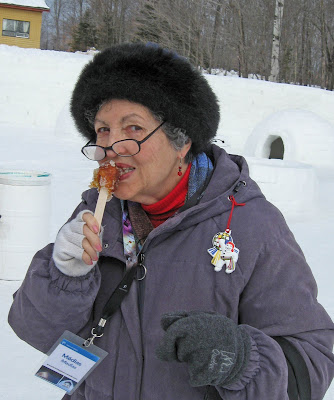
Here's something cool they do with maple syrup. They get it really hot and pour it onto clean snow.

As it cools, it gets firmer and they take a wooden stick and roll the semi-soft syrup around it.

Voila! A maple sucker!
Love,
Vanilla


 Love,
Love,


 And Snoopy and Charlie Brown weren't the only things made out of ice. This is an ice slide. Miss Elaine took me down twice! She wanted a friend to take our picture but the camera batteries were getting too cold and didn't work very well.


 White Sands covers about 275 square miles. The sands come from playa lakes -- lakes fed totally by rainfall -- that dry up when the water evaporates. The minerals in the water are left behind and eventually break down and are carried by the wind.
 The dunes don't stay in one place -- they shift with the winds. In some areas the dunes move 30 feet in one year. That's probably about the same distance as from the front to back of your classroom.


 I'm sitting in the middle of the Plaza de Obradoiro. Lots of things go on here -- people meet and visit here and musicians often play music, hoping that people will donate money.


 I made a new friend. This girl was from Germany. She loved me and would like to have taken me home but Miss Elaine explained that I was a working bear and you needed me to help you learn geography. She was sad but she understood.